“I keep getting calls from people on the other side of the city, but the customers five minutes down the road can’t find me.”
A plumber in Brunswick said that to me last year. He had a decent website, some blog posts, even a few Google reviews. But when someone in his suburb searched “plumber near me,” he was nowhere. A competitor three suburbs away was showing up instead.
The problem wasn’t his plumbing. It was his local SEO. Or rather, the lack of it.
If your business depends on customers in a specific area finding you, and you’re not showing up when they search, this guide will walk you through what’s going wrong and how to fix it. If you’re already ranking well in your local area, skip this and have a look at our broader SEO services guide or our content marketing guide instead.
What local SEO actually is
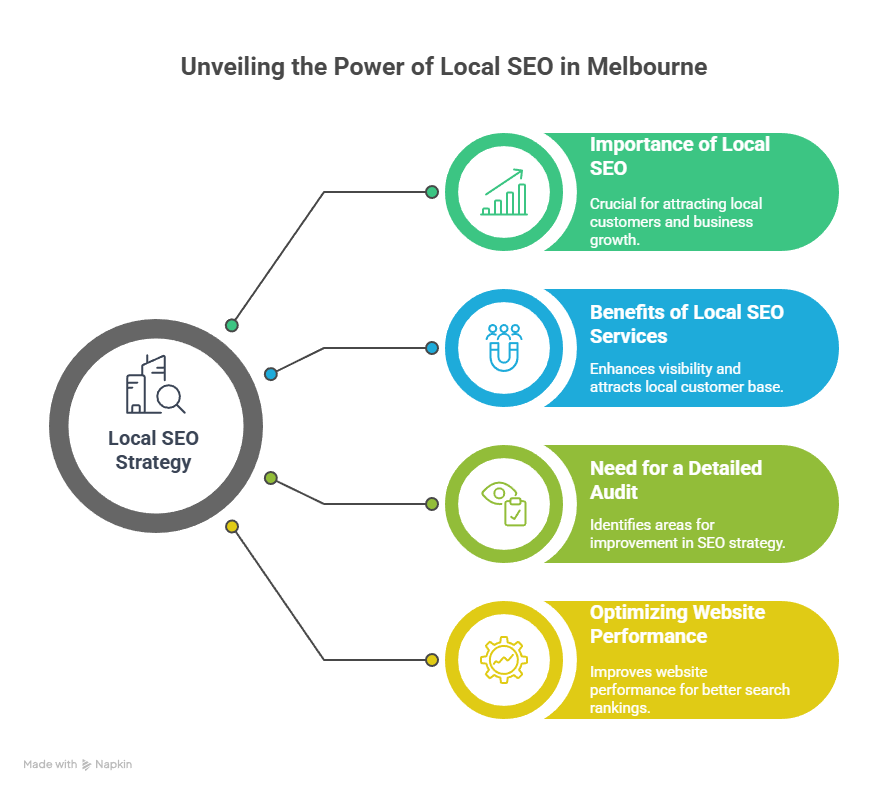
Local SEO is the process of making your business show up when someone nearby searches for what you do. That’s it. When a person in Coburg types “best coffee shop near me” or “electrician Coburg,” Google tries to show them the most relevant businesses close to their location.
There are two places you want to appear. The first is the Map Pack, which is the box with three businesses and a map that shows up near the top of search results. The second is the regular organic results below it. Most businesses focus on one and forget the other. You need both.
The way Google decides who shows up locally is different from how it ranks national or global searches. Proximity matters a lot more. So do things like your Google Business Profile, local reviews, and whether your business name, address, and phone number are consistent across the internet.
If you’ve been pouring effort into general SEO and wondering why the phone isn’t ringing from local customers, this is probably why. General SEO and local SEO overlap, but they’re not the same game.
Why Melbourne businesses keep getting this wrong
Melbourne is made up of dozens of distinct suburbs, each with its own character and its own search behaviour. Someone in Fitzroy searching for a restaurant is looking for a different answer than someone in Frankston. Google knows this, and it adjusts results accordingly.
The mistake most businesses make is treating Melbourne as one big keyword. They optimise their site for “plumber Melbourne” and call it done. But “plumber Melbourne” is a brutally competitive term, and even if you rank for it, the person searching might be 40 kilometres away from you.
What works better is targeting the suburbs and neighbourhoods where your actual customers live. “Plumber Brunswick” has less search volume than “plumber Melbourne,” but the person typing it is almost certainly closer to you, more likely to call, and facing far less competition in the search results.
We’ve seen this pattern repeat across dozens of Melbourne businesses. The ones that go narrow and local consistently outperform the ones chasing broad metro-wide terms. It’s a smaller pond, but the fish are bigger. Or to put it another way, the world is your lobster when you stop trying to be everything to everyone.
For more on targeting specific suburbs, see our guide on geo-targeted SEO for Melbourne businesses.
Google My Business drive traffic for Melbourne businesses” src=”https://maxbiz.co/wp-content/uploads/2025/03/How-Local-SEO-and-Google-My-Business-Drive-Traffic.webp” />
Google Business Profile: where most local SEO starts and stops
Your Google Business Profile is the single most important factor for showing up in the Map Pack. If you haven’t claimed yours, do that before you read another word of this guide. Go to business.google.com and set it up. Takes about fifteen minutes.
Once it’s set up, here’s what actually moves the needle.
Categories. Pick the most specific primary category that matches your business. “Plumber” is better than “Home Services.” You get one primary and several secondary categories. Use them.
Description. Write it like a human being, not a keyword-stuffing machine. Say what you do, where you do it, and who you do it for. Keep it under 750 characters.
Photos. Businesses with photos get more clicks. Not stock photos. Real photos of your shopfront, your team, your work. Google can tell the difference, and so can customers.
Posts. Google lets you publish posts directly to your profile. Most businesses never use this. The ones that post weekly with updates, offers, or tips get a small but consistent edge.
Reviews. More on this below, but the short version is: more genuine reviews from real customers equals better local rankings. There’s no shortcut here.
Reviews: the part everyone asks about
“How do I get more Google reviews?” is probably the question I hear most from Melbourne business owners. The answer is simple and annoying in equal measure: ask your customers.
After every job, every sale, every positive interaction, send a follow-up message with a direct link to your Google review page. Make it easy. Don’t make them search for you on Google, find the review button, and figure it out. Send the link.
The other half of the equation is responding to reviews. Every single one. The good ones get a quick thank you. The bad ones get a calm, professional response that shows you care about fixing problems. Google watches how you handle reviews, and so do potential customers reading them.
What you should never do is buy reviews, swap reviews with other businesses, or incentivise them with discounts. Google catches this more often than people think, and the penalty is having your profile suspended entirely. Not worth the risk.
NAP consistency: boring but necessary
NAP stands for Name, Address, Phone number. The idea is simple: wherever your business appears online, your NAP details should be identical. Same spelling, same format, same phone number.
This means your website, your Google Business Profile, your Facebook page, your listing on Yellow Pages, True Local, Yelp, and every other directory you’re on. If your website says “Suite 4, 123 Sydney Road” and your Google profile says “4/123 Sydney Rd,” that inconsistency can hurt your local rankings.
Is it tedious? Absolutely. Does it matter? More than most business owners realise. Think of it as the foundation. Nobody notices when the foundation is solid. Everyone notices when it cracks.
local SEO content in Melbourne to rank in suburb-specific searches” src=”https://maxbiz.co/wp-content/uploads/2025/01/Creating-Engaging-Local-SEO-Content-in-Melbourne.png” />
Local content: the part most businesses skip entirely
Here’s where local SEO and content marketing meet. Writing content that’s specifically about your area, your suburb, your local market, sends strong signals to Google about where your business operates.
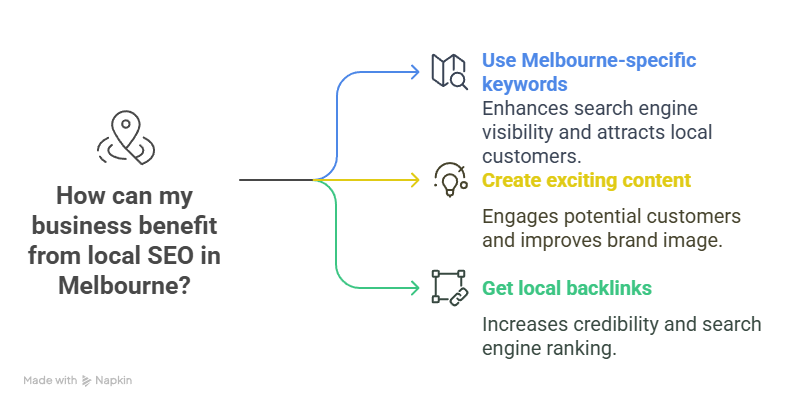
This doesn’t mean stuffing “Melbourne” into every sentence. It means creating useful content that’s genuinely relevant to people in your area. A real estate agent in Brunswick could write about the Brunswick property market specifically, not just “the Melbourne property market.” An accountant in Coburg could write about tax considerations for small businesses in that area.
We go deeper on this in our guide to local SEO content for Melbourne businesses. Our piece on local SEO content and social visibility in Melbourne covers the social media angle of this as well.
The businesses that commit to local content creation, even just one suburb-specific post per fortnight, build up a library of pages that Google associates with a geographic area. Over time, that library becomes hard to compete with.
Local link building
Links from other local businesses, local directories, local news sites, and community organisations tell Google that your business is a real, established part of the local community.
Some practical ways to build local links: sponsor a local sports team or community event and get listed on their website. Join your local chamber of commerce. Get listed in industry-specific Melbourne directories. Write a guest post for a local blog or news site.
These aren’t glamorous tactics. They’re the digital equivalent of handing out business cards at a local networking event. But they compound over time, and they’re much harder for competitors to replicate than generic link building.
Local SEO packages: what to expect
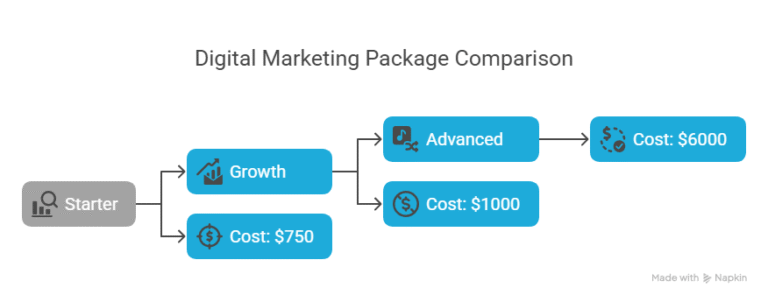
If you’re considering hiring someone to handle your local SEO, you’ll want to know what a reasonable package looks like. We break this down in more detail in our local SEO packages guide, but here’s the short version.
A basic local SEO package should include Google Business Profile optimisation, NAP audit and cleanup, local keyword research, and monthly reporting. A more comprehensive package adds local content creation, review management strategy, local link building, and competitor monitoring.
What you should be wary of is anyone who promises specific rankings by a specific date. Local SEO is influenced by dozens of factors, many of which change week to week. A good provider will tell you what they’re going to do, explain why, and show you the progress honestly, including when things aren’t moving as fast as expected.
For a broader look at different SEO package options, our local SEO packages comparison breaks it down further.
Neighbourhood SEO: going even more specific
Some of our most successful Melbourne clients have gone beyond suburb-level targeting to individual neighbourhood and precinct targeting. This works especially well for businesses in areas with distinct micro-communities.
If you’re in an area like Brunswick, for example, the search behaviour around Sydney Road is different from the search behaviour around Lygon Street. Targeting at this level requires more granular content, but the competition is practically zero.
We’ve written about this approach in our Brunswick neighbourhood SEO guide and our Brunswick SEO strategy guide if you want to see how it works in practice.
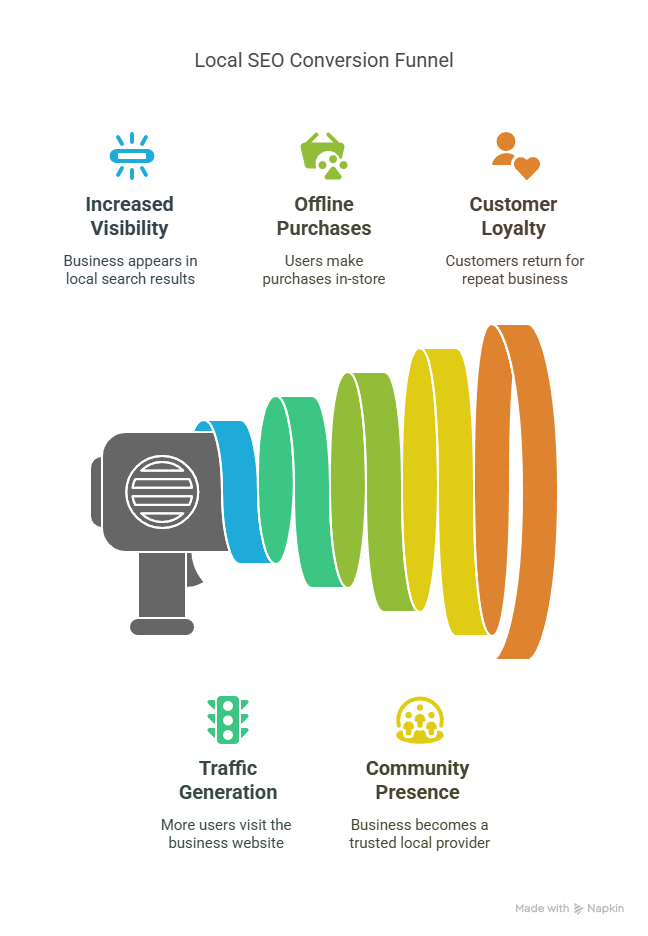
How to know if your local SEO is working
After you’ve put in the work, here’s how to measure whether it’s actually doing anything.
Check Google Business Profile Insights. This tells you how many people found your profile through search, how many asked for directions, and how many called you directly. These numbers matter more than rankings for vanity keywords.
Check Google Search Console for your location-based keywords. Are impressions going up? Are you getting clicks from the suburbs you’re targeting?
Track phone calls and form submissions. If local SEO is working, you should be getting more enquiries from people in your target area. If the calls are coming from the wrong side of the city, something needs adjusting.
Give it ninety days before you judge. Local SEO moves slower than paid ads but the results compound. A paid ad stops working the day you stop paying. Good local SEO keeps working long after the work is done.
Local SEO works best when it sits inside a broader digital marketing strategy. If you want to understand how all the pieces connect and how to choose the right agency to bring it together, our digital marketing company Melbourne guide is a good place to start.
Now that you’ve got the basics
You know what local SEO is, why it matters for Melbourne businesses, and where to start. If you want to go deeper on any of these topics, we’ve got supporting guides that cover local search visibility strategies, Melbourne’s local SEO services, the Australia-wide local SEO picture, and SEO management for specific suburbs like Brunswick.
If you need help putting a local SEO strategy together for your business, or if you’ve been doing the work and not seeing results, we’re happy to take a look and tell you what we’d do differently. Explore our Melbourne SEO services or get in touch.