Reading time: 8 minutes
Published January 4, 2025 · Last updated March 8, 2026
“We’ve been posting blogs for a year and nothing’s happened.”
I was sitting across from a business owner in Fitzroy when she told me that. Her team had published forty-something blog posts, hired a freelancer to write them, shared every single one on social media, and the needle hadn’t moved. Not on traffic, not on leads, not on anything she could measure.
When I looked at the blog, I could see why. Every post was a variation of the same four topics, none of them targeted a keyword anyone was actually searching for, and they weren’t linked to each other in any meaningful way. It was content for the sake of content. Busy work dressed up as strategy.
If that sounds like your situation, this guide will help you understand what actually works and why. If you’re already getting results from your content, skip this one and check out some of our more specific guides instead.
Content marketing means creating useful things, like articles, videos, and guides, that help the people you’re trying to reach. The idea is simple: if you consistently help people solve their problems, some of them will eventually become your customers.

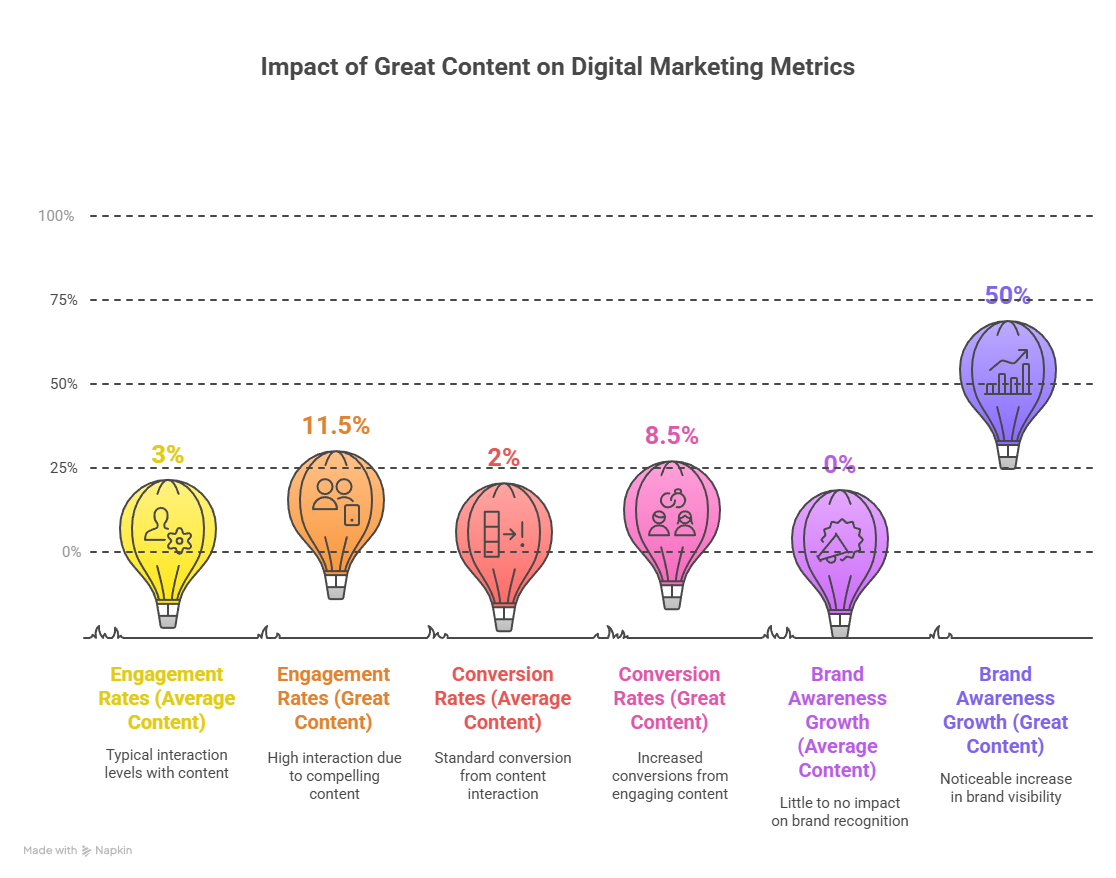
Where it goes wrong is when businesses treat content as a volume game. More posts equals more traffic equals more leads. That’s the theory, anyway. In practice, fifty mediocre posts will lose to five excellent ones every time.
The reason is Google. Google’s job is to show people the most useful result for their search. If your article on “how to choose a content marketing agency” is thin, generic, and doesn’t say anything the other ten results don’t already say, Google has no reason to show yours. And if Google doesn’t show it, nobody reads it.
So the real question isn’t “how much content should we produce?” It’s “what specific questions are our customers asking, and can we answer them better than anyone else?”
I’ve looked at thousands of blog posts across hundreds of websites at this point. The ones that actually bring in traffic and leads share a few things in common.

They target a specific search term. Not a vague topic, but an actual phrase that real people type into Google. “How to improve my Google rankings” is a search term. “Digital marketing thoughts” is not.
They answer the question completely. If someone searches “how to set up Google Business Profile,” the post should walk them through every step. Not just explain what Google Business Profile is and why it matters. That’s not answering the question. That’s stalling.
They’re structured so people can find what they need. Short paragraphs. Clear headings. The important bits near the top. Most people don’t read articles start to finish. They scan for the section that applies to them, get what they need, and leave. Make that easy and they’ll come back.
They link to related content on your site. This is the one nearly everyone misses. If you write a post about content marketing and another one about SEO, those two posts should link to each other. It helps Google understand what your site is about, and it keeps people moving through your content instead of bouncing after one page.
Melbourne is a competitive market for pretty much every service industry. There are a lot of agencies, a lot of consultants, and a lot of businesses fighting for attention in the same geographic area.
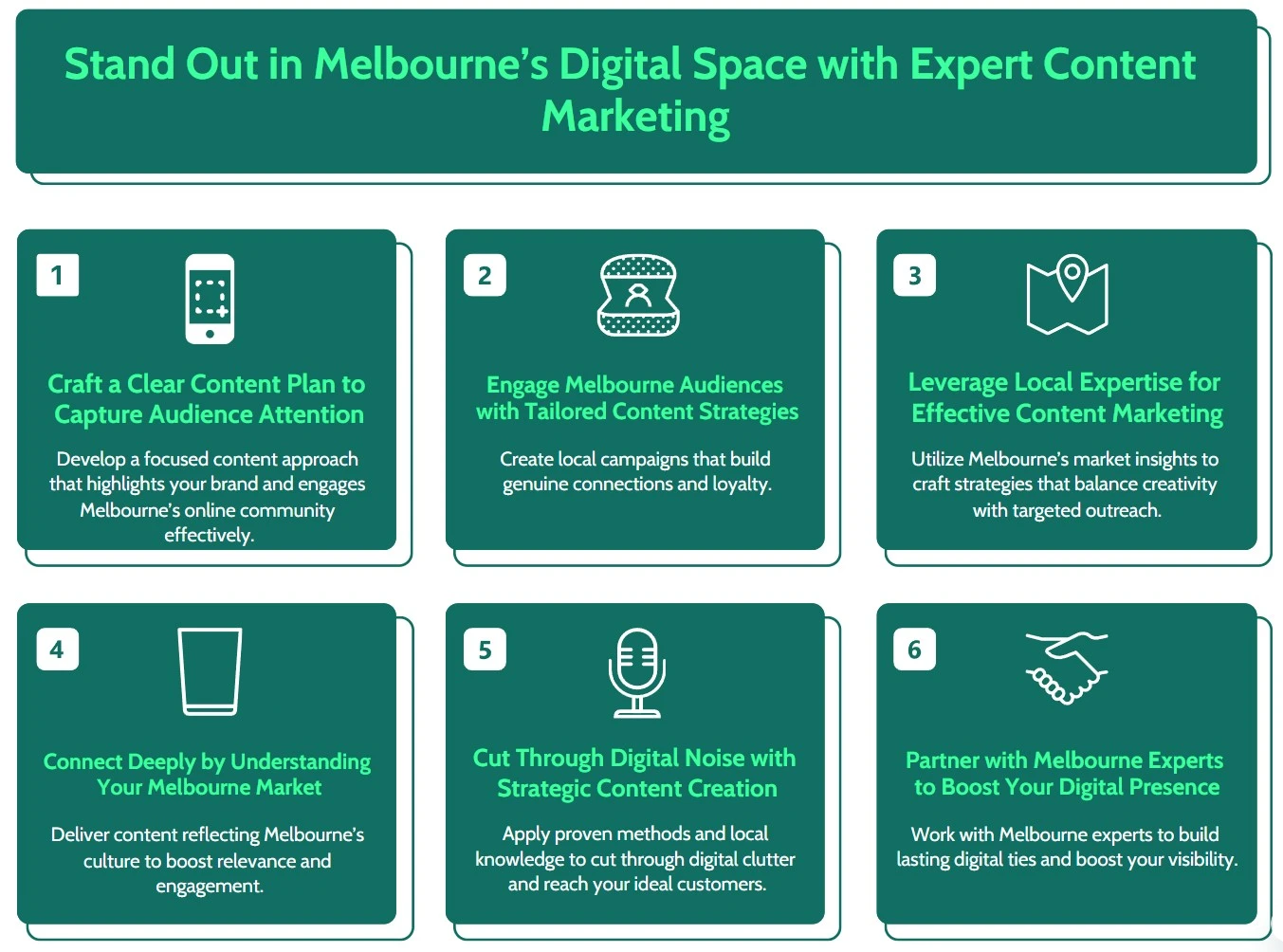
This is actually where content marketing has the biggest advantage. When you create content that’s specific to Melbourne, to your suburb, to your industry, you’re competing in a much smaller pond. “Content marketing agency” has massive competition nationally. “Content marketing for tradies in Melbourne” has almost none.
Local content also builds trust in a way that generic content doesn’t. When you write about the challenges that Melbourne businesses face specifically, the people reading it recognise their own situation. That recognition is the first step toward trust, and trust is what turns a reader into a client.
We’ve seen this play out with our own content. Posts that name specific suburbs, specific industries, specific Melbourne-based problems consistently outperform posts written for a general Australian audience.
Here’s what the process looks like when it’s done properly. Not the theory, but the actual steps.

This is keyword research, but you don’t need a degree in SEO to do it. Start by writing down the ten questions your customers ask you most often. “How much does a website cost?” “Is SEO worth it for a small business?” “What’s the difference between Google Ads and SEO?” Those are your first ten articles.
Then use a tool like Ubersuggest or Google’s Keyword Planner to check the search volume. If people are searching for it, write about it. If they’re not, you still might write about it, but it goes lower on the priority list. Discover how marketing content agency Australia can help your strategy. Discover how improve your business online with content can help your strategy. Discover how Melbourne digital content consultants can help your strategy. Discover how marketing agency near me can help your strategy.
This is the part that makes the difference between a blog and a strategy. You group your topics into clusters. Each cluster has one main page, the pillar, and several supporting pages that go deeper on specific subtopics.
For example, if you’re a content marketing agency, your pillar page might be “Content Marketing for Melbourne Businesses” and your supporting pages might cover things like blogging strategy, video content, social media content, and content for lead generation. Each supporting page links back to the pillar. The pillar links out to all the supporting pages.
This structure tells Google that your site has depth on a topic. And depth is what earns rankings.
Write it, record it, design it, whatever format fits. But here’s the important part: every piece needs to be better than what’s already ranking. Look at the top five results for your target keyword. Read them. Then make yours more useful, more specific, more actionable, or more current.
If you can’t beat what’s already there, pick a different angle or a different keyword. There’s no prize for being the sixth best result on page one.
Publishing is not the finish line. Share it with your email list. Post it on LinkedIn. Send it to clients who might find it useful. Content marketing only works if people actually see the content.
Check Google Search Console after thirty days. Is the page getting impressions? Is it ranking for the terms you targeted? If not, it might need more depth, better internal links, or a different angle. Give it ninety days before you make a judgement on whether it’s working.
If you’ve got the time and the writing ability, you can absolutely do this yourself. The strategy isn’t complicated. It’s the execution that takes time.
Most business owners I work with start doing it themselves, run out of time around month three, and the blog goes quiet for six months. Then they call me.
There’s no shame in that. Running a business is hard enough without also trying to be a publisher. If content marketing is going to work for you, it needs consistency. One well-researched, well-written post per fortnight is better than a burst of five posts followed by silence.
A good agency should handle strategy, keyword research, writing, publishing, and reporting. They should be able to explain what they’re doing and why in plain language. And they should be measuring results in terms of traffic and leads, not just word counts and publishing schedules.
Since this is literally what we do, I’ll give you the questions I’d ask if I were hiring us. Or anyone else.
Can you show me results from other Melbourne businesses? Not national case studies from giant brands. Local results from businesses roughly my size.
What does your content creation process look like? If they can’t walk you through it from keyword research to published post, they’re probably winging it.
Who actually writes the content? Is it an in-house team, freelancers, or AI? If it’s AI with a human editor, that’s fine as long as the output is good. If it’s unedited AI, you’ll end up with the same generic content you could’ve produced yourself for free.
How do you measure success? If the answer is anything other than organic traffic, keyword rankings, and leads, keep asking until you get a real answer.
Content marketing is one piece of a bigger picture. If you want to understand how all the digital marketing channels fit together and how to choose the right partner to manage them, our digital marketing company Melbourne guide covers that in detail.
You know what content marketing is, how to structure a strategy, what separates good content from filler, and what to look for if you’re hiring an agency.
If you want help building a content strategy for your Melbourne business, or if you’ve been producing content that isn’t going anywhere and want a second opinion on why, we’re happy to take a look.
You know where to find us.